Wednesday, June 30, 2010
New Electric Powertrain collaboration between Peugeot and Mitsubishi
Tuesday, June 17, 2008
Cooperative project for electric powertrains between PSA Peugeot Citroen and MMC
Paris, Tokyo, June 17, 2008 - PSA Peugeot Citroen and Mitsubishi Motors Corporation (MMC) announced today that both companies agreed to start a feasibility study on an extended technical collaboration in the field of electric powertrains.
This project, which will run over several months, relates to the development, the manufacture and the use of an electric powertrain for small urban vehicles.
To step up the viability of electric vehicle projects and accelerate market introduction, the companies agreed that cooperation on electric vehicle development and production would be mutually beneficial.
This new agreement reinforces the bonds between the two manufacturers who, a week ago, laid the first stone of their joint Russian factory, in Kaluga (180 km south west of Moscow)
For PSA Peugeot Citroen, this agreement lies within the scope of its Strategy and Ambition plan covering 2010-2015, which should maintain the PSA Group's leadership in environmentally friendly cars.
With an extensive knowledge of electric vehicles, PSA Peugeot Citroen is the largest global manufacturer of electric vehicles to date with more than 10,000 units sold. PSA Peugeot Citroen will bring to this project its expertise in the field of electric powertrains.
For MMC this agreement is consistent with its electric vehicle strategy.
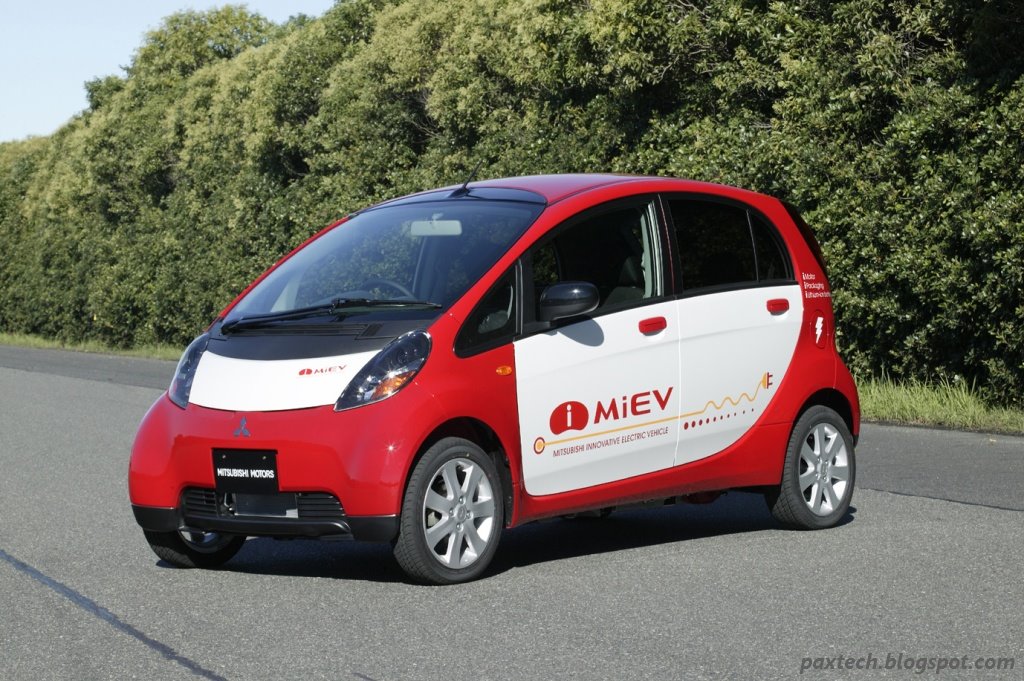
MMC, aiming to become one of the leading car manufactures of electric vehicles, has prioritized development of the i MiEV*1 new-generation electric vehicle for introduction to the market. MMC will launch the electric vehicle in the Japanese domestic market in 2009 and is considering a possible future introduction to Europe and the U.S. .
In addition, MMC has set up Lithium Energy Japan, a Joint Venture founded in partnership with GS Yuasa and Mitsubishi Corporation, which is to supply large capacity and high performance lithium ion batteries for the i MiEV. Preparation for mass-production of the batteries is going smoothly.
*1 Mitsubishi innovative Electric Vehicle, based on the "i" minicar
Friday, June 6, 2008
MMC provides i MiEV electric vehicles for use at G8 Summit

i MiEV
Tokyo, June 6 2008 — Mitsubishi Motors Corporation (MMC) today announced that it would provide 10 i MiEV*1 electric vehicles for official use at the G8 Hokkaido Toyako Summit. The electric vehicles will be used as transport for visiting world leaders and members of the media. Additionally, the vehicles will comprise one part of an on-site display*2 and test drive.
MMC hopes that through its small contribution, attendees of the G8 Summit will find a new appreciation for the superior practicality and environmental viability of electric vehicles.
MMC will bring the i MiEV electric vehicle to market next year (2009) in Japan, as part of its plan to help reduce global warming and reduce dependence on fossil fuels. The i MiEV is based on the " i " minicar, and utilizes a large-capacity lithium-ion battery and a compact, high-output electric motor in place of the traditional powertrain.
At present, MMC is conducting fleet tests in cooperation with several domestic electric power companies, in order to make electric vehicles a common sight on Japan's roads as soon as possible. Plans are also under way to begin fleet testing of the i MiEV at more than one U.S. power company as early as this fall. Data about the effects of local climate and driving preferences, gathered in the aforementioned tests, will allow MMC to make meaningful progress toward bringing the i MiEV to market.
*1 MiEV: Mitsubishi innovative Electric Vehicle
*2 The large-capacity lithium-ion battery used in the i MiEV will also will also be displayed at the event.
-MMC
Sunday, March 23, 2008
Mitsubishi Motors features mini cars at New York Int'l Auto Show

The Power of Small: Mitsubishi Motors Showcases Little Cars With Big Capabilities
March 18, 2008 -- NEW YORK --
The Mitsubishi Motors vehicles displayed at the 2008 New York International Auto Show will help North American consumers "get small" and get acquainted with Mitsubishi's renowned small car building capabilities. Tetsuro Aikawa, Managing Director In Charge of Product Development Group Headquarters, will introduce to the North American media the i, i MiEV, i MiEV Sport concept and Concept-cX minicars. The concept and production cars will raise awareness of the capability, sophistication, and design intelligence found in the Mitsubishi's minicar and compact vehicles.
Beyond the obvious advantages offered by smaller, lighter weight vehicles such as improved fuel economy, maneuverability, and reduced cost of ownership, the Mitsubishi models on display offer clever design features and capabilities traditionally associated with larger cars.
"i": To the third power
The increased congestion of urban environments, rising fuel prices, and the cumulative effects of exhaust emissions are all compelling arguments for smaller, more efficient personal transportation. The innovative design and layout of the award-winning "i" minicar showcases Mitsubishi's small car building prowess. Three "i" variants will appear at the Jacob K. Javits Convention Center, including the "i" (gasoline), the i MiEV (Mitsubishi Innovative Electric Vehicle), and the i MiEV Sport concept. The Mitsubishi Motors "i" family represents technological progress in capability and efficiency of the small car concept.
"i": Style power
On sale in Japan since 2006, the innovative "i" minicar maximizes a kei-class* car footprint to combine a smoother ride; nimble handling, interior space to accommodate four adults, all wrapped in a unique, stylish package. The "i" is powered by an aluminum three-cylinder, 660cc turbocharged, gasoline engine. This premium minicar's unique rear midship layout locates the engine ahead of the rear axle and helps the vehicle overcome the challenges for interior space, ride comfort and handling typically associated with the minicar class. The optimized interior package long (2550mm or 100.4 inches) wheelbase yields class-leading comfort, handling, and ride quality. The exterior and interior designs offer a fresh take on the traditionally boxy minicar class.
The "i" proved so successful at conquering the challenges associated with small car design that it won several major awards including the RJC (Automotive Researchers and Journalist Conference) Car of the Year 2007, and the Good Design Grand Prize 2006 (awarded by the Japan Industrial Design Promotion Organization). While the RJC award focuses on the automotive industry, the Good Design Grand Prize has a 52-year tradition and screens entries from all fields of human activity based the view that design is an essential element in all fields of everyday life and industry. The "Good Design Award 2006" received 2,918 entries from April 26th to June 7th 2006.
*The kei-class is a popular small vehicle segment in Japan that is limited to a 660cc engine and a 3375mm (132.9 inches) long x 1475mm (58 inches) wide footprint. Vehicle taxation in Japan is related to elements such as engine displacement, vehicle size, and emissions; minicars offer owners tax advantages and reduced cost of ownership.
The i MiEV electric vehicle, in its first US show appearance, improves on the efficient rear mid-ship layout by adapting a zero-emissions state-of-the-art electric drivetrain to this small car package. A durable 330-volt lithium-ion battery system is located under the floor deck, powering a permanent magnet electric motor. With this packaging, the i MiEV is able to offer the same level of interior utility and space as the gasoline version while lowering the center of gravity for more stable handling. The 47 kW electric motor offers improved performance over the 64 hp gasoline version. With instantaneous electric power, the i MiEV offers quicker acceleration compared to the gasoline version. The battery, developed by the MMC joint venture company Lithium Energy Japan, represents the leading edge in battery technology, and promises up to 100 miles of driving on a single charge. The i MiEV will launch in Japan next year (2009), adding a no-pollution solution for congested city streets.
The i MiEV Sport concept, making its North American debut in New York, maximizes the sporty possibilities of the zero-emissions electric vehicle.
The i MiEV Sport concept is a coupe variation on the i MiEV with a "fastback" roofline with a strong performance bias, leveraging the electric vehicle's natural advantages for a performance payoff. The Sport is constructed using a rigid lightweight aluminum frame that helps improve performance and range. The rear mid-ship layout (like the i MiEV) optimizes interior space and ideally situates the drivetrain's electrical components to maximize handling. In the interest of improved on-road capability, the i MiEV Sport's powertrain utilizes multiple electric motors. Two 20 kW electric motors, one built into each front wheel, work together with a single, powerful 47 kW motor that drives the rear wheels. Power output, traction and braking at all four wheels are controlled by the S-AWC (Super All-Wheel Control) system which integrates the ABS and ASC (Active Stability Control) systems to provide outstanding control and handling. For this electric vehicle application, a new E-AYC (Electronic Active Yaw Control) produces the same torque vectoring characteristics as the Lancer Evolution's AYC to give the vehicle playful road manners while maximizing stability and control.
The advanced, futuristic i MiEV Sport concept is also environmentally thoughtful in function and design. While a light green pearlescent exterior evokes thoughts of nature, the heat-absorbing window glass improves the efficiency of the air conditioning and low-drain LEDs are used throughout the vehicle including the rear combination lamps and interior lighting. An auxiliary photovoltaic generator on the roof makes effective use of solar energy; turbines in the front grille harness wind power; regenerative brakes capture motive power. The interior styling is clean, simple and fluid, allowing the driver to feel at home in this sporty, zero-emissions electric vehicle.
In addition the trio of "i" minicars, the Concept-cX will appear at the New York International Auto show.The Concept-cX showcases a forward-thinking small SUV design that offers high levels of road and environmental performance with a newly developed 1.8-liter clean diesel engine mated to a Twin Clutch SST (Sport Shift Transmission). With its high seat position providing a wider field of view and its split tailgate giving easy access to the luggage compartment, the Concept-cX offers enhanced safety, utility and convenience. The interior is a nod to the modern with a mix of black and white with warm brown leather accents. A clean, sophisticated IP allows the driver enjoyment in an appealing, comfortable environment. Energy-absorbing materials are used throughout the vehicle, including the lower bumper, to increase the ability to restore its form after minor collisions. The Mitsubishi Concept-cX is a small soft-roader for on-road use that combines a high level or utility, fuel economy and driver enjoyment.
New Additions to the Lancer Lineup - the Grown-up Compact Evolves
Also on display will be Mitsubishi's latest additions to the compact Lancer series, the high performance Lancer Evolution, the 2009 Lancer GTS 2.4 and the turbocharged Lancer Ralliart, showing how much fun can be squeezed into a smaller sedan. Building off the success of the redesigned 2008 Lancer, the 2009 Lancer GTS boasts a new 2.4L engine and combines a sport-tuned suspension with 18-inch wheels, 215/45 R18 tires and large 4-wheel disc brakes. Powered by a new 2.0-liter DOHC MIVEC intercooled and turbocharged engine that boosts an estimated 235 horsepower, the Lancer Ralliart offers a medium between the Lancer GTS and the Lancer Evolution. Set to arrive at dealerships in the summer of 2008, the Lancer Ralliart will also feature a Twin Clutch-SST gearbox and a full-time 4WD driveline with Active Center Differential (ACD).
Tuesday, May 8, 2007
GS Yuasa, MC and MMC to Establish New Company to Manufacture Lithium-ion Batteries
— Mass production of large capacity / high performance batteries, that can be used in electric vehicles —
Tokyo, May 8, 2007 — GS Yuasa Corporation (President Makoto Yoda, Head Office Minami-ku, Kyoto), Mitsubishi Corporation (President Yorihiko Kojima, Head Office Chiyoda-ku, Tokyo), and Mitsubishi Motors Corporation (President Osamu Masuko, Head Office Minato-ku, Tokyo) have begun collaboration on establishing a joint venture company to manufacture large capacity and high performance Lithium-ion batteries that can be used in electric vehicles (EV). The three partners aim to complete the details and set up the new company sometime within half a year.
GS Yuasa is expected to own a 51% share of the new company, with MC and MMC owing 34% and 15% respectively. The new company's headquarters will be located within GS Yuasa's Kyoto head office. During the first stage of development, 3 billion yen will be invested to install automated mass production lines within GS Yuasa's Kyoto head office plant, capable of manufacturing 200,000 cells per year. Operations are slated to commence by 2009.
Application of Large Lithium-ion batteries is expected to increase dramatically across a wide variety of industries, including automobiles. Construction of systems that can quickly meet these market needs has become a vital issue. GS Yuasa possesses advanced technologies in Large Lithium-ion batteries and is striving to broaden their applications. Meanwhile, MC intends to enter the battery manufacturing business and aims to create other related businesses as well. MMC is working to increase the use of the "cleanest" possible vehicles i.e., EV. The three companies decided that by combining their unique strengths, they could exhibit optimum synergy through the establishment of this new company.
The batteries that will be produced by the new company are based on the "LIM series" of Large Lithium-ion batteries manufactured by GS Yuasa (currently the only mass producer of Large Lithium-ion batteries in Japan) and thanks to a review of the certain factors such as cell-structure and electrode materials, improve energy density and power density. These new batteries have ten times the capacity of those for hybrid electric vehicles, and are the perfect choice for EVs. MMC plans to install the batteries to its next generation EV "i MiEV" (i Mitsubishi innovative Electric Vehicle), which it aims to introduce to the market by 2010. The batteries can also be supplied to EVs manufactured by other auto-makers and to industrial applications for energy storage use.
Furthermore, the new batteries are characteristic of high-speed energy input and output which comply with high-speed charge specifications under consideration by electrical power companies and potentially with plug-in hybrid electric vehicles (P-HEV). We hope that our product will become the de facto standard for Large Lithium-ion batteries, and that new company shall increase production capacity and line-up of the products in response to the expanding market.
[ Overview of New JV Company ]
1. Name Yet to be announced
2. Period of establishment Aim is within half a year
3. Location of Headquarters and factory 1, Inobanba-cho, Nishinosho, Kisshoin, Minami-ku, Kyoto, Japan
(at GS Yuasa's Kyoto Head Office)
4. Size of factory 7000m2
5. Capital Around 3 billion yen
6. Investors and percent ownership GS Yuasa 51%, MC 34%, MMC 15% (planned)
7. Type of business Manufacturing of Large capacity Lithium-ion batteries
8. Production scale 20,000 units / year in first fiscal year
[ Overview of GS Yuasa Corporation ]
1. Name GS Yuasa Corporation
2. Established April 1st, 2004
3. Head Office 1, Inobanba-cho, Nishinosho, Kisshoin, Minami-ku, Kyoto, Japan
4. Capital 16.3 billion yen
5. Type of business Manufacturing & Sales of batteries, power supply systems and lighting equipment, other batteries and electric equipment
[ Overview of Mitsubishi Corporation ]
1. Name Mitsubishi Corporation
2. Established April 1st, 1950
3. Head Office 3-1, Marunouchi 2-Chome, Chiyoda-ku, Tokyo, Japan
4. Capital 199.2 billion yen
5. Type of business General trading company (sogo shosha)
[ Overview of Mitsubishi Motors Corporation ]
1. Name Mitsubishi Motors Corporation
2. Established April 22nd, 1970
3. Head Office 33-8, Shiba 5-chome, Minato-ku, Tokyo, Japan
4. Capital 657.3 billion yen
5. Type of business Automobile development, production, sales and exports


Thursday, October 12, 2006
Mitsubishi Motors builds new research EV "i MiEV"
Mitsubishi Motors builds new research EV, "i MiEV" for joint research with power companies
Tokyo, October 11, 2006 — Mitsubishi Motors Corporation (MMC) has built a new research vehicle, the Mitsubishi innovative Electric Vehicle (MiEV)*1 for a next-generation EV development project. The electric vehicle (EV) will be used for joint research programmes with power companies that have been working on the promotion of EVs. The power companies will conduct field tests, gather data and evaluate the commercial viability of the vehicle. MMC will provide power companies with EVs and analyse field test data collected by them.
The new research EV is based on MMC's "i" mini-car, and named "i MiEV". i MiEV is powered by a compact and lightweight motor and high-energy density lithium-ion batteries. After removing the i's combustion engine mounted on the platform with an original rear-midship layout, a single motor*2 is mounted in its place. i MiEV became electric-powered with few modifications of the body structure. In addition to the joint research programmes, MMC will further improve the components of i MiEV such as the battery system, motor and EV electronic control unit for the future commercial application.

i MiEV
(MMC will display i MiEV at the 22nd International Battery, Hybrid and Fuel Cell Electric Vehicle Symposium & Exposition (EVS-22) at Pacifico Yokohama in Yokohama on October 23 - 28, 2006.)
MMC will begin joint research with Tokyo Electric Power Company, and The Chugoku Electric Power Co., Inc., in November 2006 and with Kyushu Electric Power Co., Ltd., in January 2007. MMC will provide each power company with i MiEVs. By testing i MiEV, the power companies will evaluate how the vehicle is applied to their business and how fast-charge infrastructure may be developed for EVs.
In the autumn of 2007, MMC will begin fleet testing in order to verify the vehicle's technical capabilities in daily use and to evaluate the commercial acceptance in collaboration with the power companies above along with, the Kansai Electric Power Co., Ltd., and Hokuriku Electric Power Company. MMC will provide the power companies with i MiEVs for the fleet tests. The data collected from the test of daily use shall be used to assess the commercial viability of EVs in the market place.
MMC takes environmental concerns seriously. Developing new environmental technologies and diversification of fuel sources are MMC's key challenges and the MiEV project is an approach to these. MMC is also working on other environmental technologies such as clean diesel engines and bio-fuel engines. On the social side, MMC launched a natural conservation project called the "Pajero Forest & Local Mountain Restoration Initiative", which supports conservation and management of Japan's forests.
*1 "MiEV" encompasses MMC's whole technological concept of lithium-ion battery, in-wheel motor and other technologies related to EV, hybrid electric vehicle and fuel cell vehicles. The MiEV concept is developed from MMC's former concept "Mitsubishi In-wheel motor Electric Vehicle (MIEV)", referring to a lithium-ion battery/in-wheel motor-driven vehicle. MMC continues to develop in-wheel motor technology.
*2 In this system a single electric motor is coupled to a reduction gear and differential to drive both rear wheels.
i MiEV vehicle profile
i MiEV is the third EV of MMC's MiEV series. Based on the i minicar platform, i MiEV replaces the conventional engine and fuel tank with a lithium-ion battery system, motor, inverter and other EV components in the rear-midship layout.
There are two main advantages of the rear-midship layout: increased cabin space and plenty of space for the EV power train. The layout enables the power-train to be placed in front of the rear axle line, which ensures ample cabin space for passengers (4-occupant capacity). It also provides ample space for battery storage, which could achieve the desired daily driving range of a number of customers. An on-board charger allows the vehicle to be changed ordinary electric outlets.
In addition to the high practical values, i MiEV displays higher performance levels than the base model in some categories. For example, i MiEV shows stronger torque, quieter noise and less vibration, which are natural advantages of EVs.

Vehicle layout
"i MiEV" specifications
| Base vehicle | "i" mini-car | |
| Dimensions (L x W x H) | 3395 x 1475 x 1600 mm | |
| Vehicle weight | 1080 kg | |
| Seating capacity | 4 | |
| Maximum speed | 130 km/h | |
| Cruising distance with a single charge (Driving pattern : 10-15 mode) | 130 km / 160 km* | |
| Charging time (80% capacity) | 15 Amp/200 V (on-board charger) | 5 hrs / 7 hrs* |
| 15 Amp/100 V (on-board charger) | 11 hrs / 13 hrs* | |
| 3-phase 50 kW/200 V (Quick charger) | 20 min / 25 min* | |
| Motor | Type | Permanent magnet synchronous motor |
| Max. output | 47 kW | |
| Max. torque | 180 N-m | |
| Max. speed | 8500 rpm | |
| Battery | Type | Lithium-ion |
| Total voltage | 330 V | |
| Total energy | 16 kWh / 20 kWh* | |
| Controller | Inverter | |
| Drive | Rear wheel drive | |
-Mitsubishi Motors Corporation
Wednesday, August 24, 2005
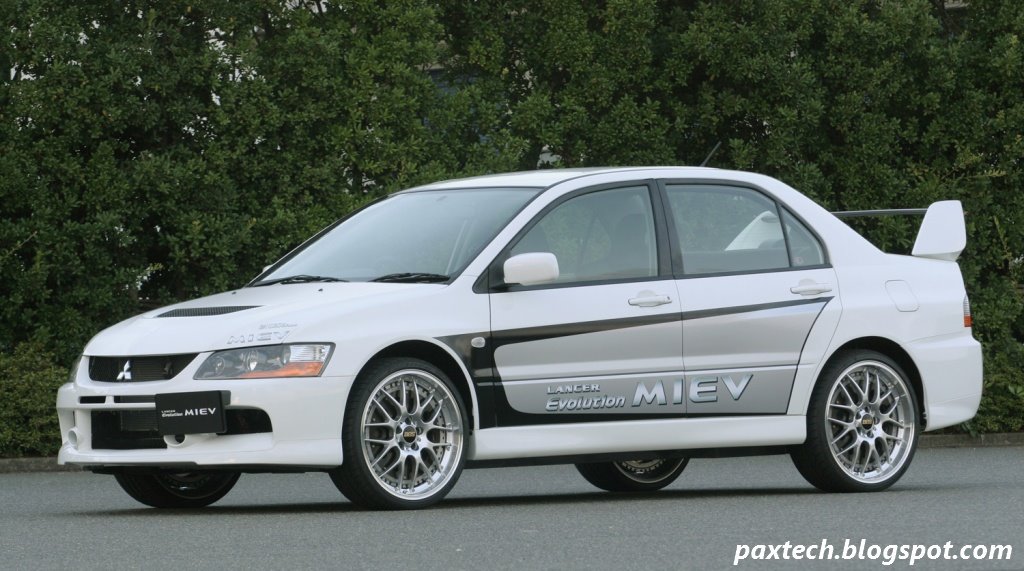
Lancer Evo IX MIEV to be entered in the Shikoku EV Rally
Mitsubishi Motors Corporation announced that it would enter a Lancer Evolution MIEV1 test vehicle in the Shikoku EV Rally 2005 to be held August 27-28 in Tokushima Prefecture on the island of Shikoku, Japan. Deriving from the Company's Lancer Evolution IX high-performance 4WD sports sedan, Lancer Evolution MIEV uses a lithium-ion battery system to power four newly developed in-wheel motors. The Shikoku EV Rally 2005 is organized by the Shikoku EV Challenge Committee and the Shikoku EV Rally 2005 Executive Committee.
Mitsubishi Motors is driving forward the development of the Mitsubishi In-wheel motor Electric Vehicle (MIEV) next-generation electric vehicle and is planning to bring a MIEV model, built around core technologies of in-wheel motors and high density lithium-ion batteries, to market by 2010.
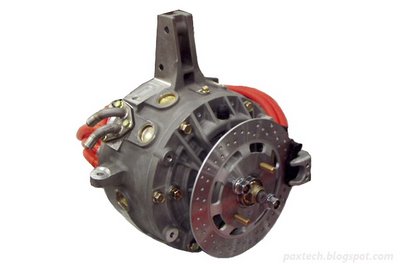
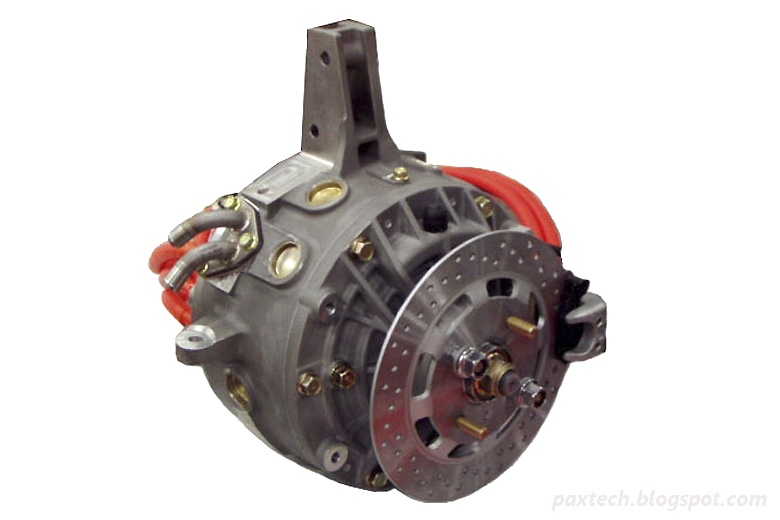
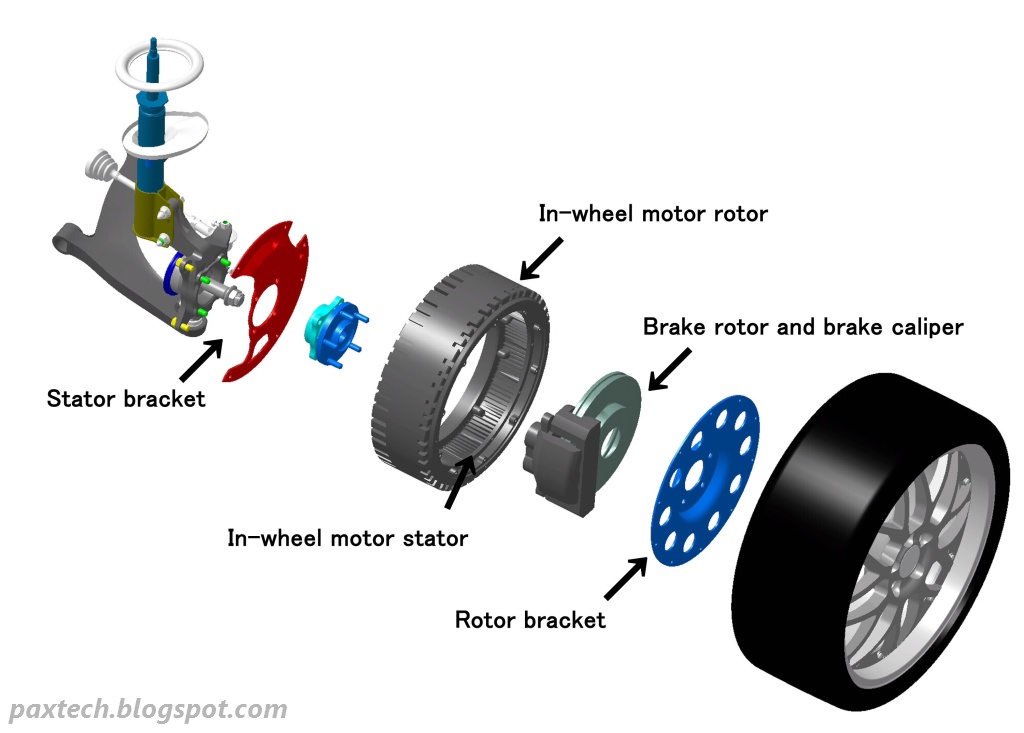
The Lancer Evolution MIEV will be the Company's second MIEV test vehicle, following the Colt EV announced in May 2005. The new in-wheel motor uses a hollow doughnut construction that locates the rotor outside the stator as opposed to a common electric motor where the rotor turns inside the stator. This construction brings several benefits. It makes it easier to raise power output and torque; higher torque allows the speed reducer unit to be eliminated, which means less weight and improved power transmission efficiency; and it offers better space efficiency with the brake assembly fitting inside the motor which itself fits neatly within the wheel house. The outer-rotor arrangement also surmounts the difficulties presented to date by the steering system, making it suitable for fitting to and driving the front wheels that opened the way to 4WD in-wheel motor vehicles.
Mitsubishi Motors has acquired vehicle type certification for Lancer Evolution MIEV and will be conducting practicality evaluations over a wide variety of conditions, the Shikoku EV Rally and other public road driving included. The evaluation programs will assist the Company in developing high-performance electric, hybrid and fuel cell vehicles that deliver not only superior environmental performance but also output performance and maneuverability equal to or better than gasoline-fueled vehicles.
1 Mitsubishi In-wheel motor Electric Vehicle
- Lancer Evolution MIEV: overview
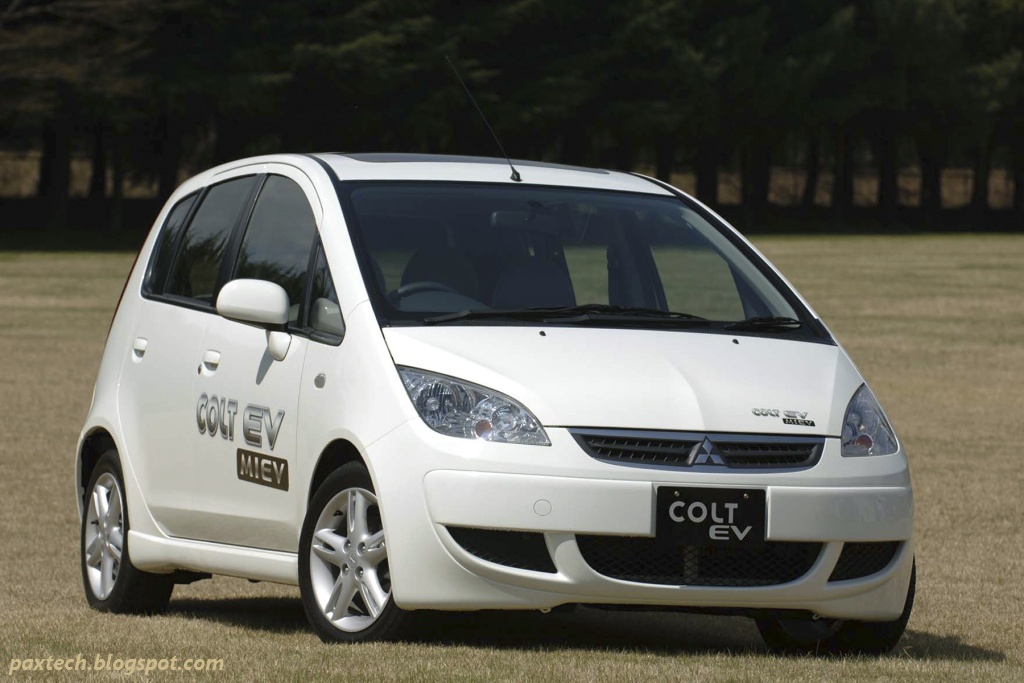
Mitsubishi Motors' MIEV concept comprises two core technologies: lithium-ion batteries, which the Company has been developing for practical application in automobiles; and the in-wheel motor that, as its name implies, mounts inside the vehicle wheels. Building upon the advantages offered by these technologies, the MIEV concept is currently the main driving force behind the Company's development of next-generation electric vehicles. Mitsubishi Motors also envisages the application of the MIEV concept in hybrid and fuel cell vehicles. The first MIEV test vehicle built by Mitsubishi Motors for in-wheel drive system development and testing purposes was the Colt EV, announced in May 2005. Derived from the standard production Colt compact model, Colt EV is driven by in-wheel motors mounted on the rear wheels and powered by a lithium-ion battery system.
With the Lancer Evolution MIEV high-performance 4WD in-wheel motor test vehicle, the Company has taken the next step forward. After removing the engine, fuel tank, transmission, differential, drive shaft and other 4WD components from the production Lancer Evolution IX sports sedan, newly developed outer-rotor in-wheel motors were mounted on all four wheels. Fitted under the floor between the front and rear wheels in the space vacated by the 4WD components, a lithium-ion battery system powers the motors.
The new in-wheel motor was developed by incorporating Mitsubishi Motors' vehicle installation technology to the motor manufactured by Toyo Denki Seizo K.K. The motor produces a maximum output of 50kW and its distinguishing feature is its outer-rotor construction. In the conventional type of in-wheel motor, as used on the Colt EV, the rotor turns inside the stator. The outer-rotor in-wheel motor, however, uses a hollow doughnut construction that locates the rotor outside the stator. The major benefits of this arrangement are as follows:
- The design makes raising power output and torque easier and makes the speed reducer unnecessary, which reduces energy losses and restrains the increase of unsprung weight.
- Elimination of the speed reducer makes the motor easier to fit into wheel house.
- The doughnut construction creates space in center of the motor for the brake assembly and other components.
One of the Company's major objectives in developing Lancer Evolution MIEV is to evaluate the outer-rotor type in-wheel motor construction, key to 4WD in-wheel motor vehicles, under an extensive range of driving conditions. To this end, Mitsubishi Motors has acquired vehicle type certification for Lancer Evolution MIEV to allow evaluation not only in the proving ground but also under normal driving conditions on public roads. These evaluations are designed to verify the reliability and durability of the outer-rotor in-wheel motor when subject to road surface inputs, to water inundation, and to exposure to sand and dirt - the major challenges this type of motor must overcome. The test program will also allow the Company to carry out research and development aimed at raising performance and at reducing weight and size.
Leveraging its trademark all-wheel control technology and know-how, Mitsubishi Motors is also considering developing a system that controls drive torque and braking force independently at each wheel and is eying its use in Lancer Evolution MIEV. The Company will aim for the realization of high-performance electric, hybrid and fuel cell vehicles that deliver not only superior environmental performance but also output performance and maneuverability equal to or better than gasoline-fueled vehicles.
Lancer Evolution MIEV layout
New outer-rotor in-wheel motor schematic Lancer Evolution MIEV: specification (base model: Lancer Evolution IX)Length 4490 mm Width 1770 mm Height 1450 mm Curb weight 1590 kg Seating capacity 5 Max. speed 180 km/h Cruising range / charge
(10-15 driving pattern)250 km Motor
(outer-rotor type)Type Permanent magnetic synchronous Maker Toyo Denki Seizo K.K. Max. output 50 kW Max. torque 518 N・m Max. speed 1500 rpm Dimensions 445 mm (dia.) x 134 mm No. fitted 4 Battery system Type Lithium-ion Maker GS Yuasa Corporation Capacity 95 Ah Voltage 14.8 V L x W x H 388 mm x 175 mm x 116 mm No. of modules 24 Controller Inverter Drive 4WD Tires 255/30ZR20 - Shikoku EV Rally 2005
Open to electric vehicles licensed for use on public roads, the Shikoku EV Rally has been staged by scientists at universities in Shikoku every year since 1998 with the purpose of promoting the use of EV's. This year marks the eighth time the Rally has been held.
Mitsubishi Motors has entered models such as the FTO-EV and Eclipse EV test cars in the Rally from the first Rally through 2003. The Company will be entering the recently completed Lancer Evolution MIEV in this year's Rally to test its driving and battery charging performance under normal driving conditions on public roads and to promote the MIEV next-generation EV concept among the general public.
Date: August 27-28 Venue: Tokushima College of Technology (Sakano-machi, Sakano-gun, Tokushima Prefecture) Organizing body: Shikoku EV Challenge Committee and Shikoku EV Rally 2005 Executive Committee Route details: 12 stages over public road with Tokushima College of Technology as the base point. Performance testing and measurement over special stages.
Gallery:

Lancer Evolution MIEV (base model Lancer Evolution IX)

New outer-rotor in-wheel motor
-Mitsubishi Motors Corporation
Wednesday, May 11, 2005
Mitsubishi Motors to drive forward development of next-generation EVs
- Colt EV test car uses in-wheel motors & lithium-ion batteries -

Colt EV in-wheel motor test vehicle (base model: Colt Sport-X)

In-wheel motor
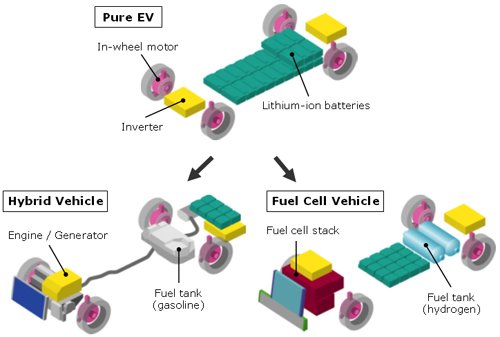
Tokyo, May 11, 2005 — Mitsubishi Motors has chosen to center its development of next-generation electric vehicle technology on in-wheel motors and on lithium-ion batteries that the company has been working on for several years. Currently working on a test vehicle that utilizes these technologies, which it has dubbed the Mitsubishi In-wheel motor Electric Vehicle (MIEV) concept, the company also envisages their application to hybrid electric vehicles and fuel cell vehicles.
The in-wheel motor makes it possible to regulate drive torque and braking force independently at each wheel without the need for any transmission, drive shaft or other complex mechanical components. For this reason, MIEV offers highly promising potential in the ongoing evolution of Mitsubishi's all-wheel control technology that is employed so successfully in the Lancer Evolution, Pajero and other 4WD models. The fact that the drive system is housed inside the wheel itself offers significantly greater design freedom and also makes it easier to locate such space-consuming components as the battery system, fuel cell stacks and hydrogen tanks used in hybrid and fuel cell vehicles.
Lithium-ion battery technology offers superior specific energy, specific power, and life over other types of rechargeable batteries and as such is expected to contribute to higher top speeds, extended cruising ranges and to greater weight reductions in hybrid and fuel cell vehicles.
Mitsubishi Motors has already started development and testing of the MIEV concept using a production compact vehicle, Colt, to serve as the rolling test bed. The Colt EV uses rear in-wheel motors powered by a lithium-ion battery system. The company is also currently developing a more powerful in-wheel motor for use in a 4WD test car. The Colt EV will be on display at the "2005 Automotive Engineering Exposition" to be held at the Pacifico Yokohama Exhibition Hall, Yokohama from May 18 through May 20.
1. MIEV concept
Mitsubishi Motors was one of the first automakers to start research into and development of the electric vehicle as an alternative fuel vehicle. In recent years, the company has turned its attention to the practical application of high-performance lithium-ion battery power to propel FTO EV and Eclipse EV experimental vehicles in 24-hour distance and public road test programs.
Exploiting the benefits of lithium-ion battery and in-wheel motor technology, the MIEV concept opens up new possibilities in terms of alternative fuel vehicle development. As well as seeking further possibilities for the EV, Mitsubishi Motors is also looking at the application of the MIEV concept to hybrid and fuel cell vehicles.
(1) In-wheel motor
I. Further evolution of all-wheel control technology
A major benefit of the in-wheel motor is that it enables drive torque and braking force to be regulated with high precision on an individual wheel basis in both two- and four-wheel drive systems without requiring transmissions, drive shafts, differential gears or other complex and heavy components. The in-wheel motor therefore holds great promise in terms of the contribution to the further evolution of Mitsubishi's all-wheel control technology that enjoys high critical acclaim on such production models as the Lancer Evolution and Pajero.
II. Greater freedom in layout design
Housing the drive system in the wheels gives greater freedom in designing the layout. This will facilitate the conversion of IC engine-powered vehicles into hybrid vehicles without requiring the introduction of complex hybrid power systems. It will also make it easier to provide room for space-consuming components such as fuel cell stacks and hydrogen tanks in fuel cell vehicles. The space-saving benefits of the in-wheel motors also offer exciting possibilities in terms of body design. Designers will be able to create innovative exteriors, improve dynamic performance through weight distribution optimization, provide roomier interior space and improve crash worthiness through optimization of the structural framework.
(2) Lithium-ion battery
Lithium-ion battery technology offers advantages of specific energy, specific power, and life over other types of rechargeable batteries. Mitsubishi Motors has already built several test vehicles using lithium-ion battery systems, including the Mitsubishi HEV in 1996, the FTO-EV in 1998 and the Eclipse EV in 2000. The FTO-EV set a multiple-charge 24-hour distance world record on a proving ground, while the Eclipse EV covered over 400 km on public roads on a single battery charge. These and other testing programs have enabled the company to verify the practical applicability of this type of battery.

MIEV schematic
2. Colt EV profile
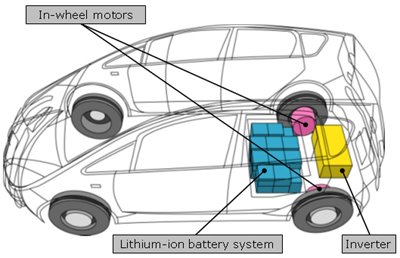
The in-wheel motor test car, Colt EV, is based on the standard compact vehicle, Colt. After removing the combustion engine, fuel tank and transmission, two in-wheel motors were fitted to the rear wheels and powered by a floor-mounted lithium-ion battery system.
Rigorous proving ground tests are now being conducted on the Colt EV. The test car is scheduled to undergo a tuning program with independent control of drive torque and braking force for left and right wheels to improve dynamic performance. After receiving vehicle type certification, Colt EV will undergo verification testing on public roads. Mitsubishi Motors will use the on-road testing program to identify and resolve any problems unique to the in-wheel motor vehicle, including any deterioration in road holding and ride comfort due to increases in un-sprung weight, as well as reliability and durability issues in the in-wheel motor system and its peripheral components (suspension, wheels, tires).
Mitsubishi Motors is continuing its motor and battery research and development programs as it seeks to improve performance while reducing size and weight. The company is currently working on a 50kW in-wheel motor for 4WD vehicle use that will eventually feature individual drive torque and braking force control for each wheel.

Colt EV layout sketch
Colt EV specifications
Base model: Colt Sport-X (1.5-liter, 4WD)
| |||||||||||||||||||||||||||||||||||||||||||||||||||||||
-Mitsubishi Motors Corporation