Showing posts with label Fuel Cell Vehicles. Show all posts

Tuesday, August 12, 2008

Honda starts leasing FCX to customers, including Jamie Lee Curtis


American Honda Motor Co., Inc., announced that its second FCX Clarity customer, Jamie Lee Curtis, took delivery of the vehicle on July 31, 2008. Curtis and husband Christopher Guest are the second of approximately 200 customers who will begin leasing the vehicle in the United States and Japan over the next three years.

"I really wasn't expecting it to be so luxurious," said Curtis. "It's luxurious, luxurious, luxurious! I love the interior layout, design and access to controls. It is user-friendly and very modern."

Actress and children's book author Curtis and her husband, filmmaker Guest, live in Santa Monica. They have owned other alternative fuel and hybrid vehicles and continue to seek out ways to live and advocate a greener lifestyle.

Ron Yerxa and Annette Ballester, Santa Monica residents, took delivery of the first FCX Clarity on July 25, 2008.

The FCX Clarity is a next-generation, hydrogen-powered fuel cell vehicle. Significant advances over Honda's previous generation FCX include a 25 percent increase in combined fuel economy to 72 miles/kg-H2* (74 mpg GGE ) and a greater than 30 percent increase in driving range up to 280 miles*. Propelled by an electric motor that runs on electricity generated in the fuel cell, the vehicle's only by-products are heat and water, and its fuel efficiency is three times that of a modern gasoline-powered automobile.

2009 Honda FCX Clarity Hydrogen Fuel Cell vehicle [US]

Honda unveiled the FCX Clarity fuel cell vehicle at the Los Angeles Auto Show, announcing plans to begin limited retail marketing of the vehicle in the US, starting summer 2008.

The FCX Clarity is a next-generation, zero-emissions, hydrogen-powered fuel cell vehicle based on the entirely-new Honda V Flow fuel cell platform, and powered by the highly compact, efficient and powerful Honda V Flow fuel cell stack. Featuring tremendous improvements to driving range, power, weight and efficiency - and boasting a low-slung, dynamic and sophisticated appearance, previously unachievable in a fuel cell vehicle - the FCX Clarity marks the significant progress Honda continues to make in advancing the real-world performance and appeal of the hydrogen-powered fuel cell car.

"The FCX Clarity is a shining symbol of the progress we've made with fuel cell vehicles and of our belief in the promise of this technology," said Tetsuo Iwamura, American Honda president and CEO. "Step by step, with continuous effort, commitment and focus, we are working to overcome obstacles to the mass-market potential of zero-emissions hydrogen fuel cell automobiles."

American Honda plans to lease the FCX Clarity to a limited number of retail consumers in Southern California with the first deliveries taking place in summer 2008.

Full details of the lease program will be set closer to launch, but current plans call for a three-year lease term with a price of $600 per month, including maintenance and collision insurance. American Honda is also developing a service infrastructure that provides customers with the best balance of convenience and the highest quality of service. When the FCX Clarity requires periodic maintenance, customers will simply schedule a visit with their local Honda dealer. American Honda will transport the vehicle to their fuel cell service facility, located in the greater Los Angeles area, where all required work will be performed. At the completion of the work, the customer will pick up their car from the dealer.

How It Works
The FCX Clarity utilizes Honda's V Flow stack in combination with a new compact and efficient lithium ion battery pack and a single hydrogen storage tank to power the vehicle's electric drive motor. The fuel cell stack operates as the vehicle's main power source. Hydrogen combines with atmospheric oxygen in the fuel cell stack, where chemical energy from the reaction is converted into electric power used to propel the vehicle. Additional energy captured through regenerative braking and deceleration is stored in the lithium ion battery pack, and used to supplement power from the fuel cell, when needed. The vehicle's only emission is water.

Honda V Flow Fuel Cell Platform
The FCX Clarity's revolutionary new V Flow platform packages the ultra-compact, lightweight and powerful Honda V Flow fuel cell stack (65 percent smaller than the previous Honda FC stack) in the vehicle's center tunnel, between the two front seats. Taking advantage of a completely new cell configuration, the vertically-oriented stack achieves an output of 100 kilowatts (kW) (versus 86kW in the current Honda FC stack) with a 50 percent increase in output density by volume (67 percent by mass). Its compact size allows for a more spacious interior and more efficient packaging of other powertrain components, which would otherwise be unattainable in a sleek, low-slung sedan.

The FCX Clarity boasts numerous other significant advances in the performance and packaging of Honda fuel cell technology, compared to the current-generation FCX. These include1:

· a 20-percent increase in fuel economy - to the approximate equivalent of 68 mpg2 combined fuel economy (about 2-3 times the fuel economy of a gasoline-powered car, and 1.5 times that of a gasoline-electric hybrid vehicle, of comparable size and performance);

· a 30-percent increase in vehicle range - to 270 miles;

· a 25-percent improvement in power-to-weight ratio, in part from an approximate 400-pound reduction in the fuel cell powertrain weight, for superior performance and efficiency despite a substantial increase in overall vehicle size;

· a 45-percent reduction in the size of the fuel cell powertrain - nearly equivalent, in terms of volume, to a modern gas-electric hybrid powertrain;

· an advanced new lithium-ion battery pack that is 40 percent lighter and 50 percent smaller than the current-generation FCX's ultra-capacitor; and

· a single 5,000-psi hydrogen storage tank with 10 percent additional hydrogen capacity than the previous model.

FCX Clarity Design
More than just a fuel cell vehicle - the FCX Clarity speaks to Honda's vision of the future of automobile design and performance freed from the constraints of conventional powertrain technologies. The FCX Clarity's four-door sedan platform features a short-nose body and spacious cabin with comfortable accommodations for four people and their luggage. Major powertrain components - including the electric motor, fuel cell stack, battery pack and hydrogen tank - have been made more compact and are distributed throughout the vehicle to further optimize space, comfort and total vehicle performance.

Advanced Materials and Components
In keeping with its theme as an environmentally-advanced automobile, the FCX Clarity features seat upholstery and door linings made from Honda Bio-Fabric - a newly-developed, plant-based material that offers CO2 reductions as an alternative to traditional interior materials, along with outstanding durability and resistance to wear, stretching, and damage from sunlight.

Designed to appeal to forward-thinking customers seeking the ultimate in zero-emissions, alternative-fuel vehicle performance, the FCX Clarity is also equipped with a full compliment of advanced safety, comfort and convenience features, including a state-of-the-art navigation system with hydrogen station locations, backup camera, premium audio, climate-controlled seats and Bluetooth™ connectivity.

Other improvements, such as shift-by-wire, electric power steering (EPS), and a newly-designed instrument panel with an easy-to-read hydrogen fuel-consumption display, further improve its customer appeal and ease of operation.

CO2 Emissions
The FCX Clarity's only emission is water. Carbon Dioxide (CO2) emissions come only from the production of hydrogen, which varies by source; however, well-to-wheel CO2 emissions using hydrogen reformed from natural gas - the most widely used method of production today - are less than half that of a conventional gasoline vehicle. With the production of hydrogen from water by electrolysis, CO2 emissions can be further reduced and ultimately approach zero if the electricity used for electrolysis is generated using solar, wind, water or nuclear power.

Honda has developed its own solar cells, with half of the CO2 emissions in the production stage compared to conventional crystalline silicon cells; and has begun mass-production and retail sales of this technology in Japan for both commercial and residential use.

Fuel Cell Leadership
Based on its vision of, "Blue Skies for our Children", Honda has worked for forty years at reducing the environmental impact of the automobile, including efforts to reduce emissions, boost fuel efficiency and, now, many industry-leading efforts to advance the hydrogen fuel cell vehicle - a technology and fuel that Honda believes may hold the ultimate promise for a clean and sustainable transportation future. Honda's pioneering achievements in this area include the first EPA and CARB certification of a fuel cell vehicle (2002); the first lease of a fuel cell vehicle (2002); the first fuel cell vehicle to receive an EPA fuel economy rating (2002); the first cold-weather customer (2004); the first and still only individual retail customers (2005, 2007); and the first and still only fuel cell vehicle to be eligible for a federal tax credit.


Wednesday, May 11, 2005

Mitsubishi Motors to drive forward development of next-generation EVs

Mitsubishi Motors to drive forward development of next-generation EVs
- Colt EV test car uses in-wheel motors & lithium-ion batteries -


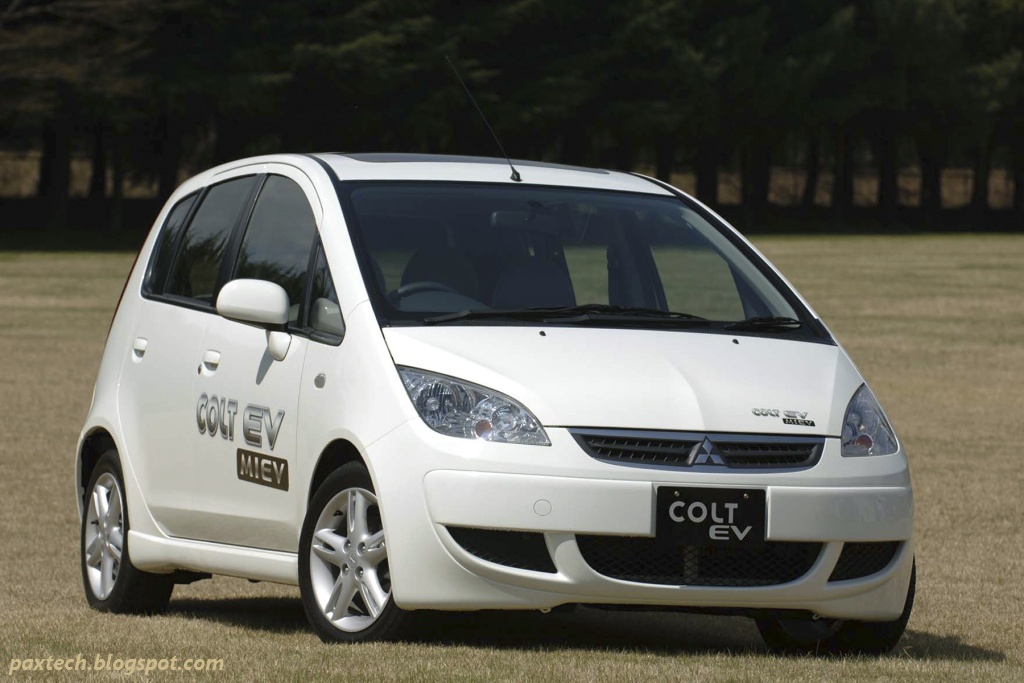
Colt EV in-wheel motor test vehicle (base model: Colt Sport-X)


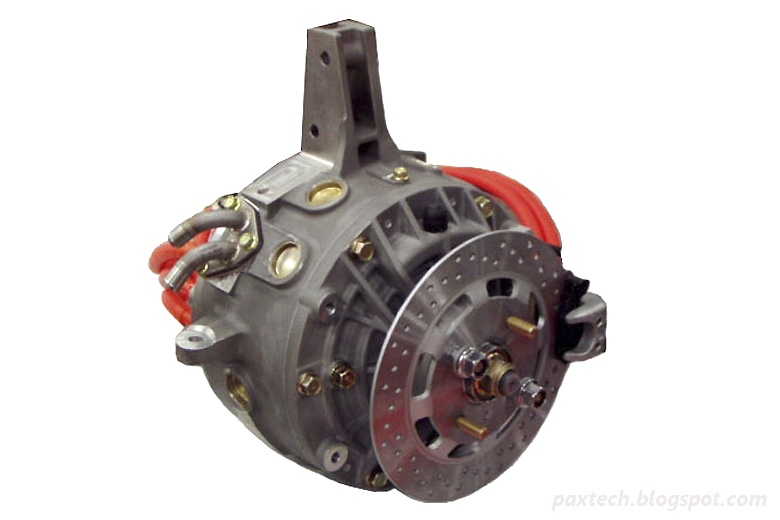
In-wheel motor

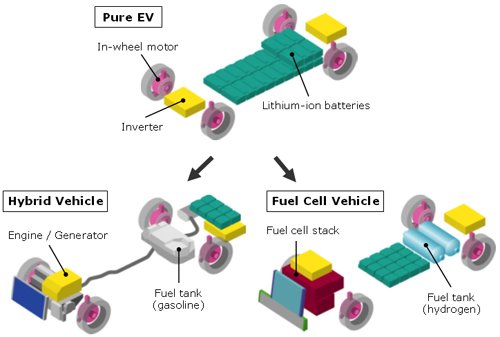
Tokyo, May 11, 2005 — Mitsubishi Motors has chosen to center its development of next-generation electric vehicle technology on in-wheel motors and on lithium-ion batteries that the company has been working on for several years. Currently working on a test vehicle that utilizes these technologies, which it has dubbed the Mitsubishi In-wheel motor Electric Vehicle (MIEV) concept, the company also envisages their application to hybrid electric vehicles and fuel cell vehicles.

The in-wheel motor makes it possible to regulate drive torque and braking force independently at each wheel without the need for any transmission, drive shaft or other complex mechanical components. For this reason, MIEV offers highly promising potential in the ongoing evolution of Mitsubishi's all-wheel control technology that is employed so successfully in the Lancer Evolution, Pajero and other 4WD models. The fact that the drive system is housed inside the wheel itself offers significantly greater design freedom and also makes it easier to locate such space-consuming components as the battery system, fuel cell stacks and hydrogen tanks used in hybrid and fuel cell vehicles.

Lithium-ion battery technology offers superior specific energy, specific power, and life over other types of rechargeable batteries and as such is expected to contribute to higher top speeds, extended cruising ranges and to greater weight reductions in hybrid and fuel cell vehicles.

Mitsubishi Motors has already started development and testing of the MIEV concept using a production compact vehicle, Colt, to serve as the rolling test bed. The Colt EV uses rear in-wheel motors powered by a lithium-ion battery system. The company is also currently developing a more powerful in-wheel motor for use in a 4WD test car. The Colt EV will be on display at the "2005 Automotive Engineering Exposition" to be held at the Pacifico Yokohama Exhibition Hall, Yokohama from May 18 through May 20.

1. MIEV concept

Mitsubishi Motors was one of the first automakers to start research into and development of the electric vehicle as an alternative fuel vehicle. In recent years, the company has turned its attention to the practical application of high-performance lithium-ion battery power to propel FTO EV and Eclipse EV experimental vehicles in 24-hour distance and public road test programs.

Exploiting the benefits of lithium-ion battery and in-wheel motor technology, the MIEV concept opens up new possibilities in terms of alternative fuel vehicle development. As well as seeking further possibilities for the EV, Mitsubishi Motors is also looking at the application of the MIEV concept to hybrid and fuel cell vehicles.

(1) In-wheel motor

I. Further evolution of all-wheel control technology
A major benefit of the in-wheel motor is that it enables drive torque and braking force to be regulated with high precision on an individual wheel basis in both two- and four-wheel drive systems without requiring transmissions, drive shafts, differential gears or other complex and heavy components. The in-wheel motor therefore holds great promise in terms of the contribution to the further evolution of Mitsubishi's all-wheel control technology that enjoys high critical acclaim on such production models as the Lancer Evolution and Pajero.

II. Greater freedom in layout design

Housing the drive system in the wheels gives greater freedom in designing the layout. This will facilitate the conversion of IC engine-powered vehicles into hybrid vehicles without requiring the introduction of complex hybrid power systems. It will also make it easier to provide room for space-consuming components such as fuel cell stacks and hydrogen tanks in fuel cell vehicles. The space-saving benefits of the in-wheel motors also offer exciting possibilities in terms of body design. Designers will be able to create innovative exteriors, improve dynamic performance through weight distribution optimization, provide roomier interior space and improve crash worthiness through optimization of the structural framework.

(2) Lithium-ion battery

Lithium-ion battery technology offers advantages of specific energy, specific power, and life over other types of rechargeable batteries. Mitsubishi Motors has already built several test vehicles using lithium-ion battery systems, including the Mitsubishi HEV in 1996, the FTO-EV in 1998 and the Eclipse EV in 2000. The FTO-EV set a multiple-charge 24-hour distance world record on a proving ground, while the Eclipse EV covered over 400 km on public roads on a single battery charge. These and other testing programs have enabled the company to verify the practical applicability of this type of battery.


MIEV schematic

2. Colt EV profile

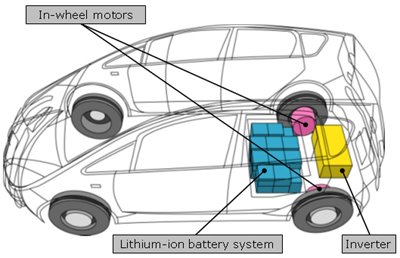
The in-wheel motor test car, Colt EV, is based on the standard compact vehicle, Colt. After removing the combustion engine, fuel tank and transmission, two in-wheel motors were fitted to the rear wheels and powered by a floor-mounted lithium-ion battery system.

Rigorous proving ground tests are now being conducted on the Colt EV. The test car is scheduled to undergo a tuning program with independent control of drive torque and braking force for left and right wheels to improve dynamic performance. After receiving vehicle type certification, Colt EV will undergo verification testing on public roads. Mitsubishi Motors will use the on-road testing program to identify and resolve any problems unique to the in-wheel motor vehicle, including any deterioration in road holding and ride comfort due to increases in un-sprung weight, as well as reliability and durability issues in the in-wheel motor system and its peripheral components (suspension, wheels, tires).

Mitsubishi Motors is continuing its motor and battery research and development programs as it seeks to improve performance while reducing size and weight. The company is currently working on a 50kW in-wheel motor for 4WD vehicle use that will eventually feature individual drive torque and braking force control for each wheel.


Colt EV layout sketch


Colt EV specifications
Base model: Colt Sport-X (1.5-liter, 4WD)

Length 3885 mm
Width 1680 mm
Height 1550 mm
Curb weight 1150 kg
Occupants 5
Max. speed 150 km/h
Cruising range / charge (10-15 driving pattern) 150 km
Motor
(with internal reduction gear)
Type Permanent magnetic synchronous
Max. output 20 kW
Max. torque 600 Nm
Max. speed 1500 rpm
Dimensions 310mm (dia.) x 220mm
No. fitted 2
Battery Type Lithium-ion
Capacity 40 Ah
Voltage 14.8 V
L x W x H 194 mm x 175 mm x 116 mm
No. of modules 22
Controller Inverter
Drive Rear wheels
Tires 185/55R15

-Mitsubishi Motors Corporation